
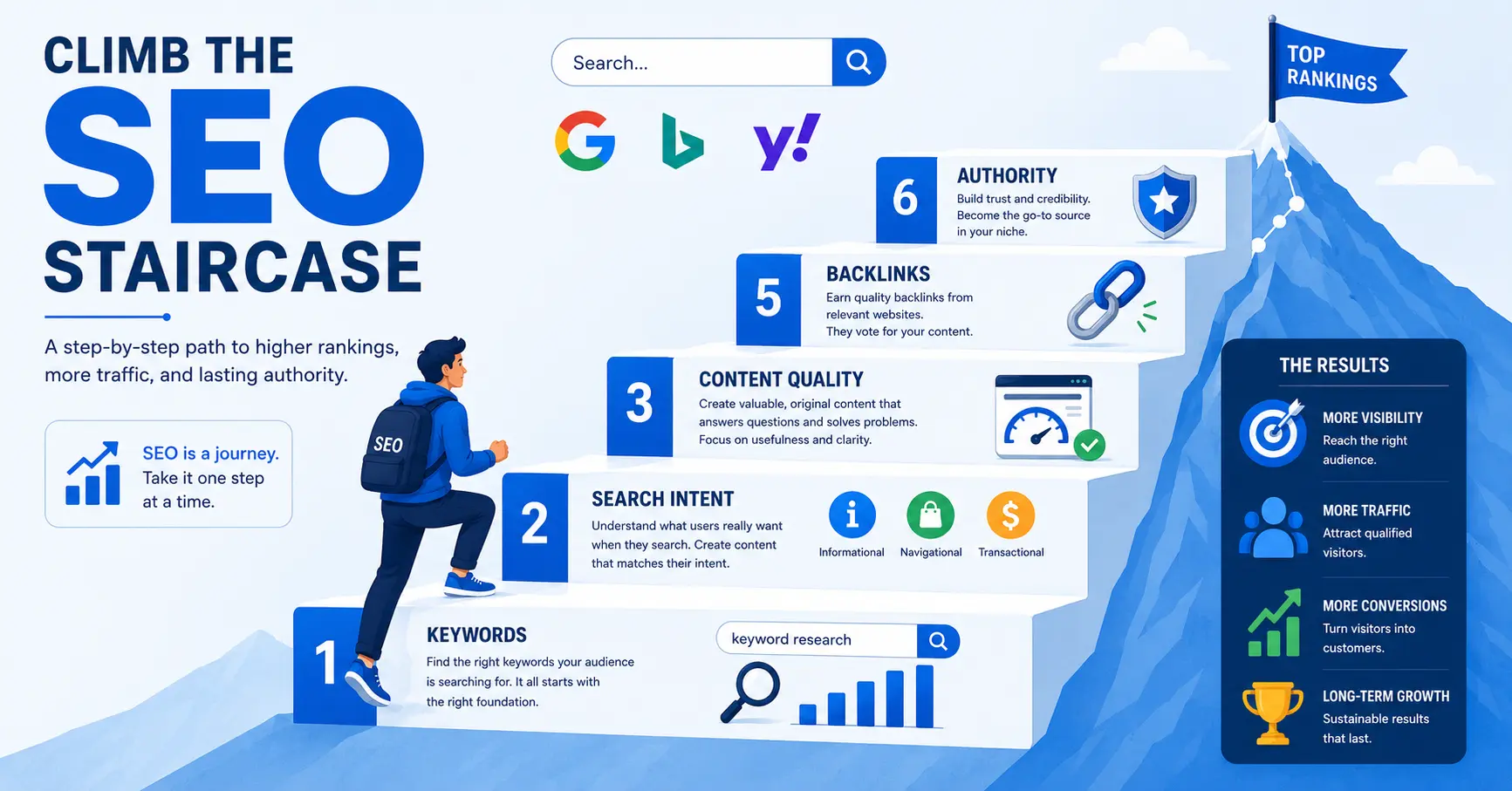
Most beginners think SEO is a trick.
A hidden setting. A plugin. A secret formula.
That idea usually disappears the first time they publish an article, wait three weeks, and see absolutely nothing happen.
SEO is less like flipping a switch and more like building reputation in a crowded city. Search engines are trying to answer one question repeatedly:
“Which page deserves to be trusted for this search?”
Once you understand that, SEO becomes far easier to approach.
Not simpler. But clearer.
Let’s go ahead in the SEO Guide.
What SEO Really Means
Search Engine Optimization is the process of helping search engines understand:
- what your content is about
- who it helps
- whether it deserves visibility
Search engines are not reading pages like humans. They interpret signals.
Some signals are obvious:
- page titles
- keywords
- links
- loading speed
Others are behavioral:
- whether users stay
- whether they return to search immediately
- whether other websites reference your page
The strongest SEO strategy is usually the least glamorous one:
Create pages that solve a specific problem better than competing pages.
Everything else supports that goal.
The Beginner Mistake That Wastes the Most Time
New site owners often start with competition-heavy keywords.
Examples:
- “fitness”
- “insurance”
- “best laptop”
- “marketing”
Those search terms are already dominated by massive websites with years of authority.
A smaller site grows faster by targeting narrower searches first.
Instead of:
- “coffee”
You might target:
- “best coffee beans for cold brew at home”
Instead of:
- “SEO tools”
You might target:
- “SEO tools for local service businesses”
That shift changes everything.
You stop competing with giant publishers and start answering precise searches with clear intent.
How Search Engines Decide Rankings
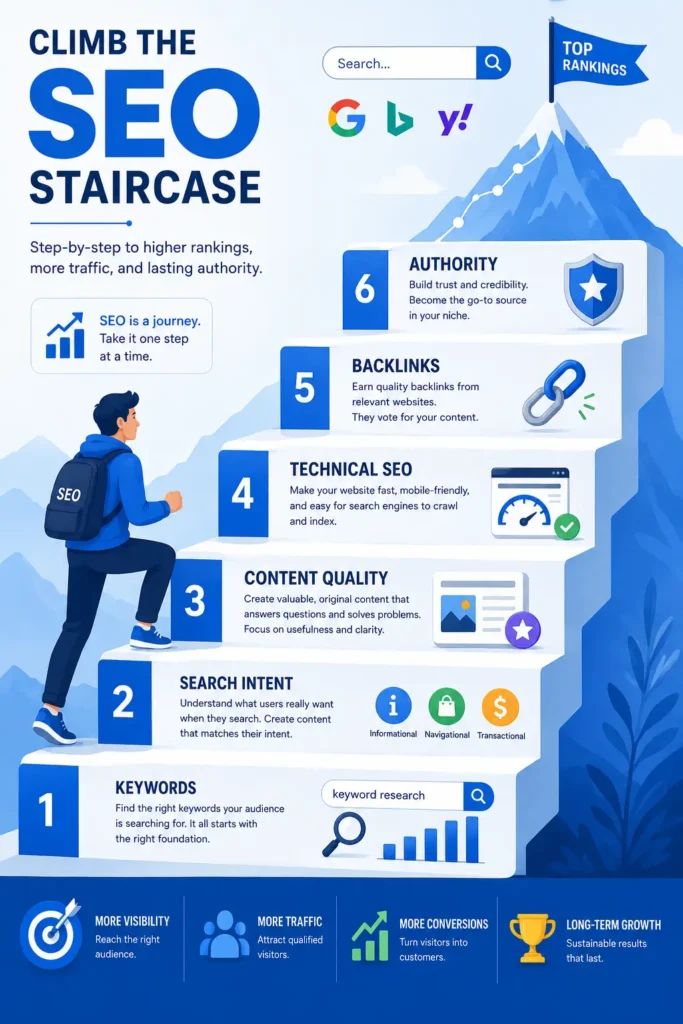
Search engines evaluate pages through layers of trust.
Here are the four biggest ones beginners should understand.
1. Relevance
Your page must clearly match the search query.
If someone searches:
- “how to clean white sneakers”
They do not want:
- sneaker history
- fashion philosophy
- a generic shoe article
They want practical cleaning steps.
Search intent matters more than keyword repetition.
2. Content Depth
Thin pages rarely survive competitive search results anymore.
Search engines reward content that:
- answers follow-up questions
- explains context
- reduces confusion
- solves the problem completely
This does not mean writing 5,000 words for everything.
It means eliminating unanswered gaps.
3. Authority
Authority grows when trustworthy websites mention or link to your content.
This is why backlinks still matter.
If ten respected sites reference your article, search engines interpret that as a credibility signal.
A backlink is essentially a public recommendation.
Not all links are equal.
One quality mention from a respected industry site can outweigh hundreds of weak directory links.
4. User Experience
A useful page can still struggle if the experience is frustrating.
Common issues:
- slow loading
- aggressive popups
- poor mobile design
- unreadable formatting
- cluttered layouts
Search engines increasingly reward usability because poor experiences push users away.
Keywords: The Part Most Beginners Overcomplicate
Keywords are not magic phrases.
They are clues about user intent.
A beginner mistake is stuffing the exact phrase everywhere:
“best running shoes”
“best running shoes”
“best running shoes”
That approach feels unnatural and often weakens the page.
Modern SEO relies more on topical relevance than mechanical repetition.
A stronger article naturally includes related language:
- running support
- marathon shoes
- arch stability
- road running
- lightweight trainers
Search engines understand relationships between terms far better than they did years ago.
The Easiest SEO Structure to Follow
If you are publishing blog content, this structure works surprisingly well:
Start with the Core Problem
Avoid long introductions.
Users arrived because they want something solved.
Get there quickly.
Explain the “Why”
Most weak articles only provide steps.
Useful content explains reasoning.
Example:
Don’t just say “compress images.”
Explain that oversized images slow loading speed, which affects both user retention and rankings.
Add Specific Examples
Generic advice is forgettable.
Specific examples create trust.
Weak:
- “Use better headlines.”
Stronger:
- “A headline like ‘How I Increased Organic Traffic by 62% in 90 Days’ creates curiosity and specificity.”
Anticipate Confusion
Good SEO content answers the next question before the reader asks it.
This improves engagement naturally.
On-Page SEO Basics Beginners Should Learn First
You do not need advanced technical knowledge to improve rankings.
Start here.
Title Tags
Your title should:
- explain the page clearly
- include the target keyword naturally
- create curiosity without sounding manipulative
Weak:
- “SEO Guide Tips”
Better:
- “SEO guide for Beginners: 9 Fundamentals That Actually Matter”
Headings
Use headings to organize information logically.
This helps:
- readers scan quickly
- search engines understand page structure
Clear hierarchy matters more than clever wording.
Internal Links
Link to related pages on your own website.
This helps search engines discover content and understand topical relationships.
It also keeps visitors engaged longer.
Image Optimization
Images should:
- load quickly
- include descriptive alt text
- support the topic visually
Huge image files quietly damage performance.
Technical SEO Without the Jargon
Technical SEO sounds intimidating mostly because of the terminology.
At beginner level, focus on fundamentals:
- your site should load fast
- pages should work on mobile devices
- broken links should be fixed
- URLs should be readable
- pages should be indexable
That covers more ground than most people realize.
You do not need to become a developer to build search visibility.
Why Consistency Beats Viral Traffic
One successful article rarely builds a strong website.
SEO compounds gradually.
A site with:
- 100 useful pages
- consistent publishing
- clear topical focus
usually outperforms a site chasing random viral spikes.
Search engines reward patterns.
Consistency is a pattern.
The Fastest Way to Learn SEO
Publish something.
Then observe what happens.
Beginners often consume endless tutorials without creating pages.
Real understanding comes from:
- publishing
- updating
- testing headlines
- improving weak pages
- watching ranking movement
SEO becomes easier once you see real search behavior attached to real content.
SEO Tools Beginners Should Actually Use
You do not need expensive software immediately.
A simple beginner stack:
- Google Search Console for indexing and search data
- Google Analytics for traffic analysis
- Yoast SEO for basic optimization (learn more on yoast seo guide)
- Ahrefs or Semrush later for keyword and backlink research
Most beginners buy advanced SEO tools before they understand search intent. That usually creates confusion instead of progress.
What SEO Looks Like in 2026
Search engines have become dramatically better at detecting shallow content.
Pages written purely to rank often feel empty now.
The sites growing fastest tend to have:
- original experience
- topical depth
- strong structure
- useful examples
- clear expertise
- authentic problem-solving
The future of SEO looks less like manipulation and more like demonstrated usefulness.
Ironically, that makes good writing more valuable again.
Final Thought
SEO feels overwhelming when viewed as a technical puzzle.
It becomes manageable once you treat it as communication.
Your job is not to impress an algorithm.
Your job is to create the page that best deserves to answer a search.
When enough users agree, rankings tend to follow.
SEO Guide FAQs:
How long does SEO take to work?
Most websites begin seeing meaningful movement within 3 to 6 months if content is published consistently and optimized properly.
Is SEO free?
SEO itself is not paid advertising, but it requires time, effort, tools, and content creation resources.
Do beginners need backlinks?
Yes, but early growth usually comes more from strong content and proper keyword targeting than aggressive link building.
Can AI-written content rank on Google?
Yes, but only if the content is genuinely useful, original, and well-structured. Low-quality mass-produced content struggles increasingly.
Is technical SEO necessary for beginners?
Basic technical SEO matters. Advanced technical optimization can come later.
How many keywords should one page target?
Usually one primary topic plus closely related supporting terms works best.
Summary:
SEO guide for beginners becomes much easier once you stop treating it like a secret system and start treating it like reputation-building. Focus on search intent, useful content, clean structure, and consistency. Those fundamentals remain surprisingly effective even as algorithms evolve.
CTA:
Starting SEO is less about mastering every ranking factor and more about building your first genuinely useful page. Publish consistently, study what performs, and improve over time. That process teaches more than any checklist.