

Traffic rarely comes from guessing.
Most websites that grow consistently are built on a repeatable system: identify what people are searching for, understand why they are searching, and create content that answers the intent better than competitors.
That process begins with a reliable keyword research tool.
Not all keywords are valuable. Some generate impressions but no clicks. Others bring visitors who never convert. The real advantage comes from finding phrases with strong intent, realistic competition, and enough demand to justify creating content around them.
This is where keyword research becomes strategic instead of mechanical.
Why Keyword Research Still Matters in Modern SEO
Search engines have become significantly better at understanding topics, entities, and user intent. But keywords still provide one of the clearest signals about:
- what audiences want
- how they phrase problems
- what stage of the buying journey they are in
- how competitive a topic is
- where opportunities exist
A good keyword strategy helps you avoid publishing content nobody searches for.
It also prevents another common issue: targeting broad terms that are almost impossible to rank for.
For example:
- “Shoes” is broad and highly competitive
- “Best waterproof trail running shoes for monsoon trekking” is specific and intent-driven
The second phrase may have lower traffic, but it often produces better engagement and conversions.
<u>Modern SEO rewards specificity, relevance, and intent alignment.</u>
What a Keyword Research Tool Actually Does
A keyword research tool helps uncover search data and related opportunities around a topic.
Most tools provide:
- keyword suggestions
- monthly search estimates
- keyword difficulty
- trend analysis
- CPC (cost-per-click) data
- related search queries
- question-based keywords
- SERP competition insights
Some tools also cluster keywords semantically, which is increasingly useful for topical authority strategies.
Core Metrics You Should Understand
1. Keyword Search Volume
This estimates how many times a keyword is searched monthly.
High volume does not automatically mean high value.
Sometimes a keyword with 500 monthly searches outperforms one with 20,000 because the intent is clearer.
2. Keyword Difficulty
This indicates how difficult it may be to rank on the first page.
Difficulty is influenced by:
- domain authority of competitors
- backlink profiles
- content quality
- search intent saturation
3. Search Intent
This matters more than volume alone.
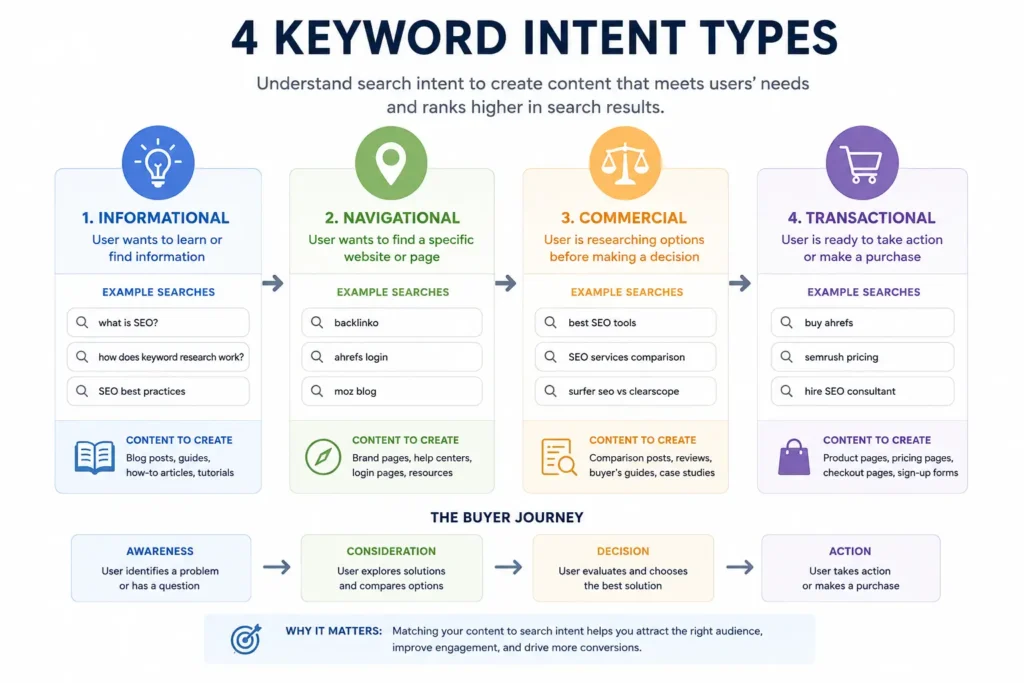
Search intent usually falls into four categories:
| Intent Type | Example |
|---|---|
| Informational | “keyword research how to” |
| Navigational | “Ahrefs keyword tool” |
| Commercial | “best free keyword tool” |
| Transactional | “buy SEO software” |
Content should match the dominant intent shown in search results.
How to Do Keyword Research Effectively
Many beginners treat keyword research like data collection.
Experienced marketers treat it like audience analysis.
Here’s a more effective workflow.
Step 1: Start With Broad Topic Seeds
Begin with general themes related to your niche.
Examples:
- digital marketing
- fitness nutrition
- remote work software
- AI writing tools
A keyword tool expands these into hundreds of variations.
For example, entering “keyword research” may generate:
- keyword research free
- keyword research how to
- free keyword tool
- keyword search volume checker
- SEO keyword planner
At this stage, volume matters less than discovering patterns.
Look for:
- recurring modifiers
- pain-point phrases
- comparison terms
- beginner-focused questions
- industry-specific wording
Step 2: Analyze Search Intent Carefully
One of the biggest SEO mistakes is creating the wrong content type for a keyword.
If search results show:
- tutorials → create educational content
- product pages → create commercial pages
- comparison articles → create comparisons
- videos → consider multimedia content
Google already tells you what users expect.
Your job is to align with that expectation while improving usefulness.
Step 3: Prioritize Low-Competition Opportunities
Smaller websites should rarely start with ultra-competitive terms.
Instead, focus on:
- long-tail keywords
- question-based phrases
- underserved subtopics
- regional variations
- intent-rich queries
Examples:
- “keyword research how to for beginners”
- “free keyword tool for YouTube SEO”
- “keyword search volume without paid tools”
These are easier entry points.
Over time, topical authority compounds.
Step 4: Evaluate SERP Quality, Not Just Metrics
A keyword may appear competitive numerically but still have weak search results.
Check:
- outdated content
- thin articles
- poor UX
- irrelevant ranking pages
- missing subtopics
If top-ranking pages fail to fully satisfy intent, you may have an opening.
This manual evaluation is where strong SEO strategists outperform automated workflows.
Best Free Keyword Tool Options Worth Using
You do not always need expensive software initially.
Several platforms offer strong free capabilities.
Google Keyword Planner
Best for:
- PPC and baseline search data
- discovering keyword ranges
- commercial intent research
Strength:
Direct Google data source.
Limitation:
Broad search ranges unless running ads.
Google Search Console
Best for:
- discovering keywords you already rank for
- CTR optimization
- identifying near-page-one opportunities
This is often the most underrated SEO data source.
Ubersuggest
Best for:
- beginner-friendly keyword discovery
- content ideas
- basic competition insights
Useful for smaller content teams and bloggers.
AnswerThePublic
Best for:
- question-based keyword discovery
- FAQ generation
- conversational search trends
Excellent for semantic SEO and AI-search optimization.
Ahrefs Free Tools
Best for:
- backlink-based keyword insights
- SERP overviews
- competitor analysis
Even limited free access can provide useful directional data.
Why Keyword Search Volume Can Mislead You
A common misconception:
Higher volume always means better opportunity.
Not necessarily.
Consider these scenarios:
| Keyword | Volume | Intent Quality |
|---|---|---|
| “SEO” | Very High | Extremely broad |
| “best keyword research tool for bloggers” | Moderate | High commercial intent |
| “keyword research free” | Medium | Strong beginner interest |
Lower-volume phrases often convert better because they represent clearer intent.
<u>Relevance beats raw traffic.</u>
The Rise of Semantic Keyword Research
Older SEO strategies focused heavily on exact-match phrases.
Modern search engines understand context much better.
This means effective keyword research now includes:
- related entities
- topic clusters
- semantic relevance
- contextual terminology
- user intent mapping
Instead of repeating one keyword excessively, build content depth around the broader topic ecosystem.
For example, an article about keyword research may naturally include:
- SERP analysis
- topical authority
- search intent
- long-tail keywords
- ranking difficulty
- search demand
This creates richer relevance signals.
Common Keyword Research Mistakes
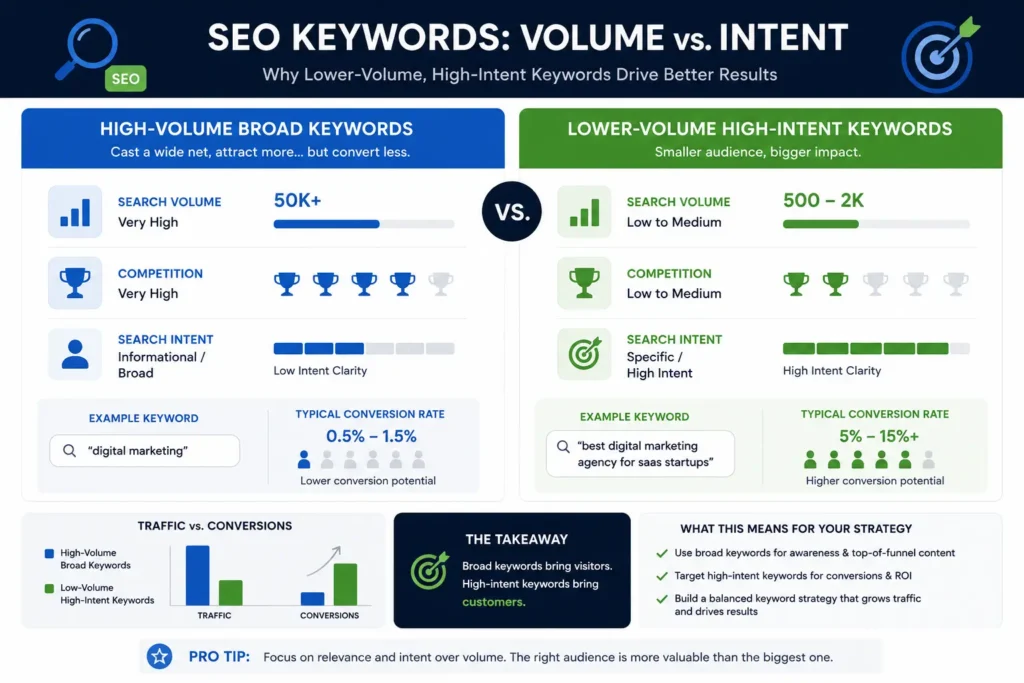
Targeting Only High-Volume Keywords
Competitive vanity terms consume resources quickly.
Balance volume with attainability.
Ignoring Intent
A perfectly optimized article still fails if it mismatches user expectations.
Intent alignment is foundational.
Overusing Exact Keywords
Keyword stuffing weakens readability and trust.
Use natural language variations instead.
Skipping Competitor Analysis
Competitor research reveals:
- content gaps
- topic opportunities
- structural improvements
- SERP weaknesses
Publishing Without Topical Strategy
Single isolated articles rarely build lasting SEO authority.
Clusters perform better than disconnected posts.
Keyword Research for AI Search and Future SEO
AI-powered search systems increasingly evaluate:
- topical completeness
- factual relevance
- entity relationships
- clarity
- structured organization
This changes how content should be planned.
Strong keyword research today is less about inserting phrases and more about understanding:
- user context
- topic depth
- semantic relationships
- intent sequencing
The websites that adapt early will likely gain long-term visibility advantages.
A Practical Keyword Research Workflow
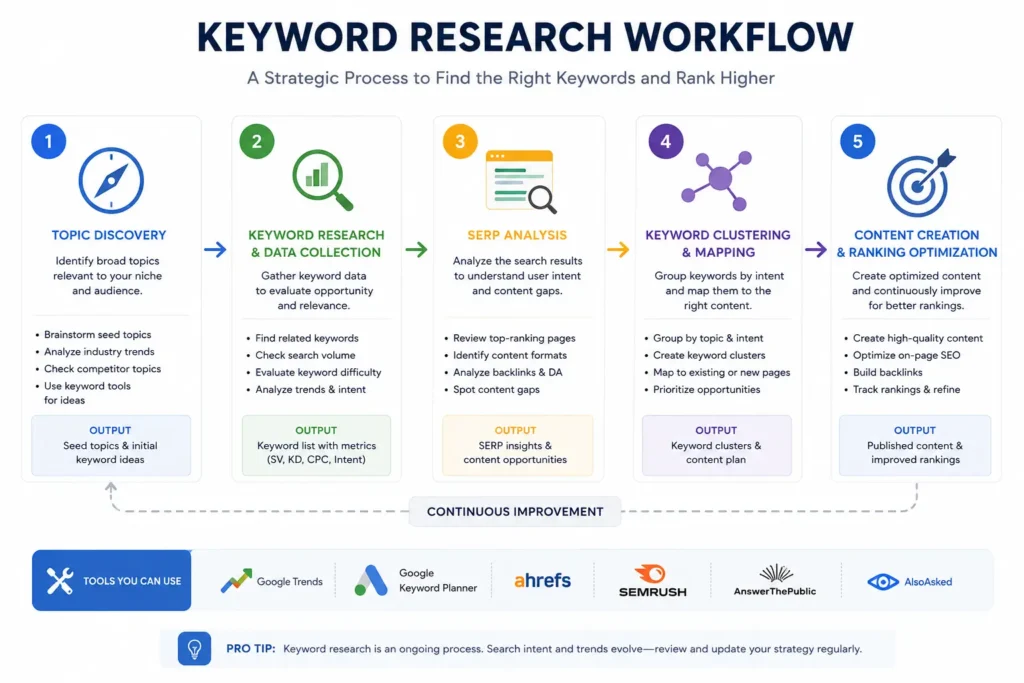
Here’s a streamlined process many modern content teams use:
- Choose a broad topic
- Use a keyword research tool for expansion
- Group keywords by intent
- Analyze SERP competition
- Prioritize attainable opportunities
- Build topical clusters
- Create intent-matched content
- Track rankings and refine continuously
Consistency matters more than finding a single “perfect” keyword.
Final Thoughts
A good keyword research tool does more than generate lists.
It reveals how audiences think, search, compare, and decide.
The real value comes from interpreting that data strategically.
The strongest SEO content usually combines:
- realistic competition targeting
- clear intent alignment
- semantic depth
- topical authority
- useful structure
- genuinely helpful information
Tools provide the data.
Strategic interpretation creates the results.
FAQs:
What is the best free keyword tool for beginners?
Google Keyword Planner, Ubersuggest, and Google Search Console are strong beginner-friendly options. Each offers different insights into keyword ideas and search behavior.
How important is keyword search volume?
Search volume helps estimate demand, but it should not be the only factor. Intent quality and competition are often more important for actual results.
Can I do keyword research free?
Yes. Many platforms offer limited free access that is sufficient for beginners, bloggers, and smaller websites.
How do I find low-competition keywords?
Focus on long-tail phrases, question-based queries, and niche-specific search terms with clear intent.
Is keyword research still relevant with AI search?
Yes. AI search systems still rely heavily on topic relevance, intent alignment, and semantic relationships—all of which start with effective keyword research.
Summary:
Keyword research is no longer just about finding high-volume phrases. Effective SEO now depends on understanding search intent, topical relevance, and semantic relationships. Using the right keyword research tool helps uncover realistic ranking opportunities, build authority, and create content that aligns with how people actually search.