
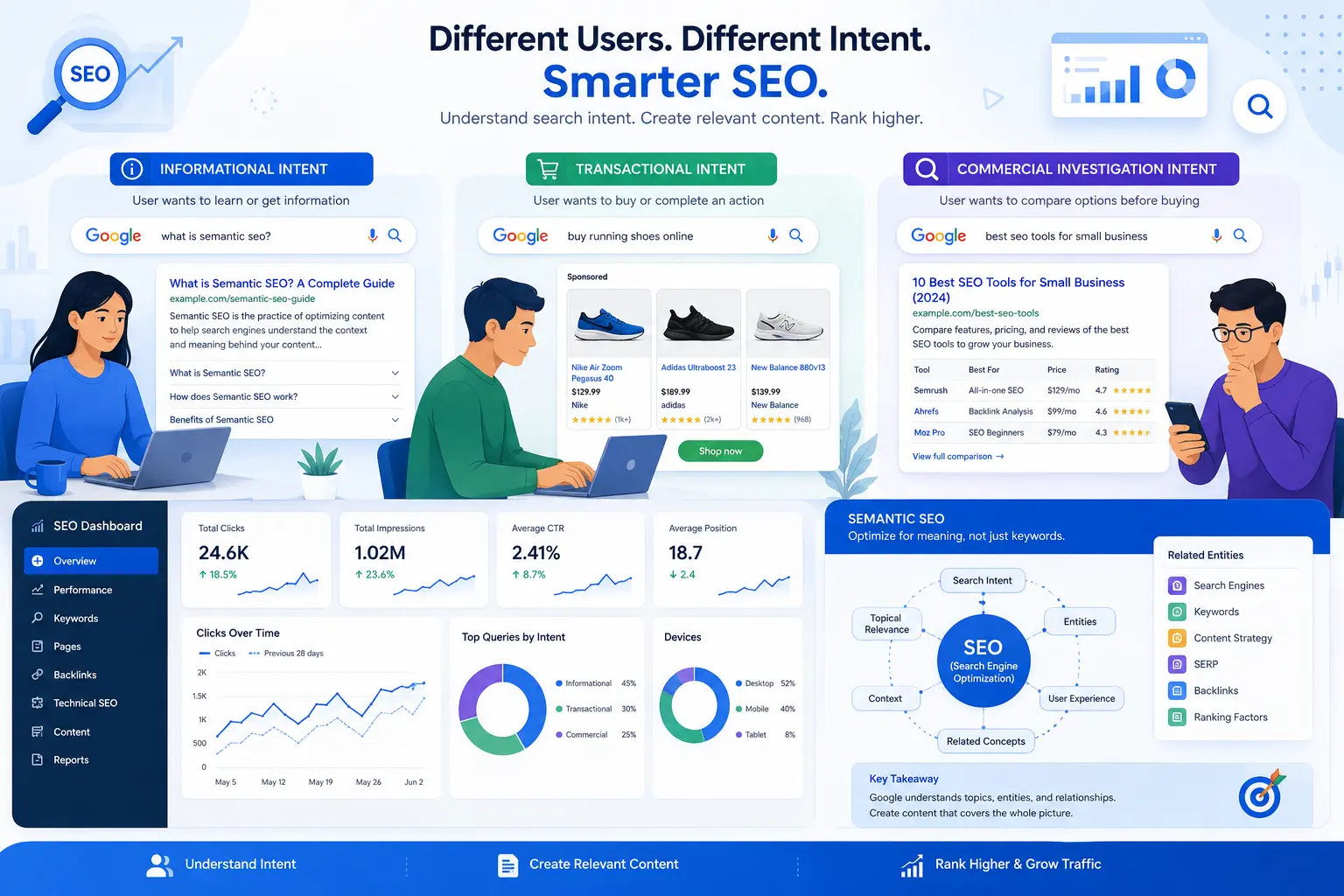
A page can rank for thousands of terms and still fail.
That usually happens when the content targets keywords but ignores keyword intent — the reason someone searched in the first place.
Modern search engines are no longer matching pages only by phrases. They evaluate behavior patterns, topical relevance, user satisfaction, and contextual meaning. A keyword without intent alignment is just text. A keyword with intent alignment becomes discoverable, clickable, and useful.
This is where many SEO strategies quietly break down.
A page optimized for “best running shoes” cannot behave like a product manual. A user searching “how running shoes affect knee pain” is in a completely different decision stage than someone typing “buy lightweight running shoes size 10.”
Same topic. Different intent. Different expectations.
Understanding this distinction changes how content should be planned, written, optimized, and structured.
What Is Keyword Intent?
Keyword intent refers to the purpose behind a search query.
It answers the deeper question:
What does the user actually want when typing this into Google?
Search engines analyze this continuously through:
- click behavior
- dwell time
- pogo-sticking
- content engagement
- semantic relevance
- historical search patterns
This is why two pages targeting similar SEO keywords can perform dramatically differently.
The intent behind the search shapes:
- content format
- page structure
- search snippets
- conversion potential
- ranking eligibility
The Four Core Types of Search Intent
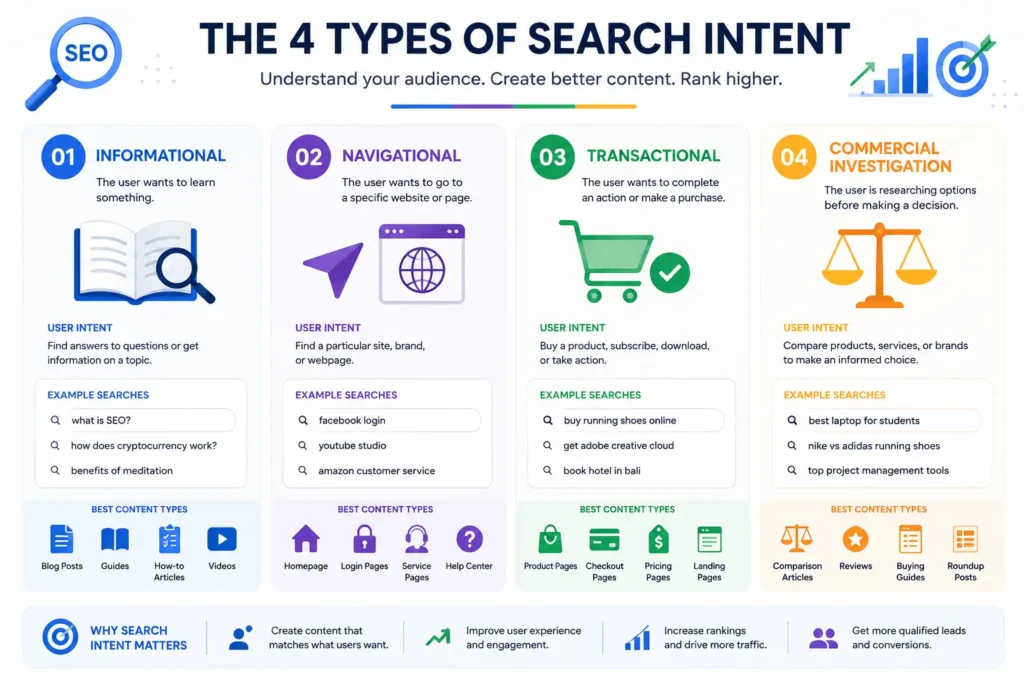
Understanding the categories of search intent helps create content that matches user expectations more precisely.
1. Informational Intent
The user wants to learn something.
Examples:
- “what is keyword intent”
- “how Google understands search intent”
- “SEO basics for beginners”
Best content formats:
- guides
- tutorials
- explainers
- educational blogs
The goal here is clarity and trust, not immediate selling.
2. Navigational Intent
The user already knows where they want to go.
Examples:
- “Google Search Console”
- “Ahrefs login”
- “YouTube Studio”
These searches are destination-focused.
Ranking for navigational searches is usually dominated by brand authority.
3. Transactional Intent
The user is ready to take action.
Examples:
- “buy SEO tools”
- “best SEO software pricing”
- “hire SEO consultant”
These searches have strong commercial value because the user is closer to conversion.
Content should focus on:
- trust
- friction reduction
- comparisons
- proof
- clear CTAs
4. Commercial Investigation Intent
This is the research phase before purchase.
Examples:
- “best keyword research tools”
- “Semrush vs Ahrefs”
- “top AI SEO tools”
The user is evaluating options.
This stage often produces the highest long-term SEO value because it attracts highly engaged visitors.
Why Keyword Intent Matters More Than Exact Match Keywords
Years ago, SEO focused heavily on exact phrases.
Today, Google understands:
- semantic relationships
- contextual meaning
- entity connections
- user interaction signals
A page optimized aggressively for google search keywords without satisfying intent often loses rankings over time.
Search engines now prioritize:
- usefulness
- contextual depth
- experience alignment
- query satisfaction
This means:
<u>Intent matching is now a ranking factor indirectly reinforced through user behavior.</u>
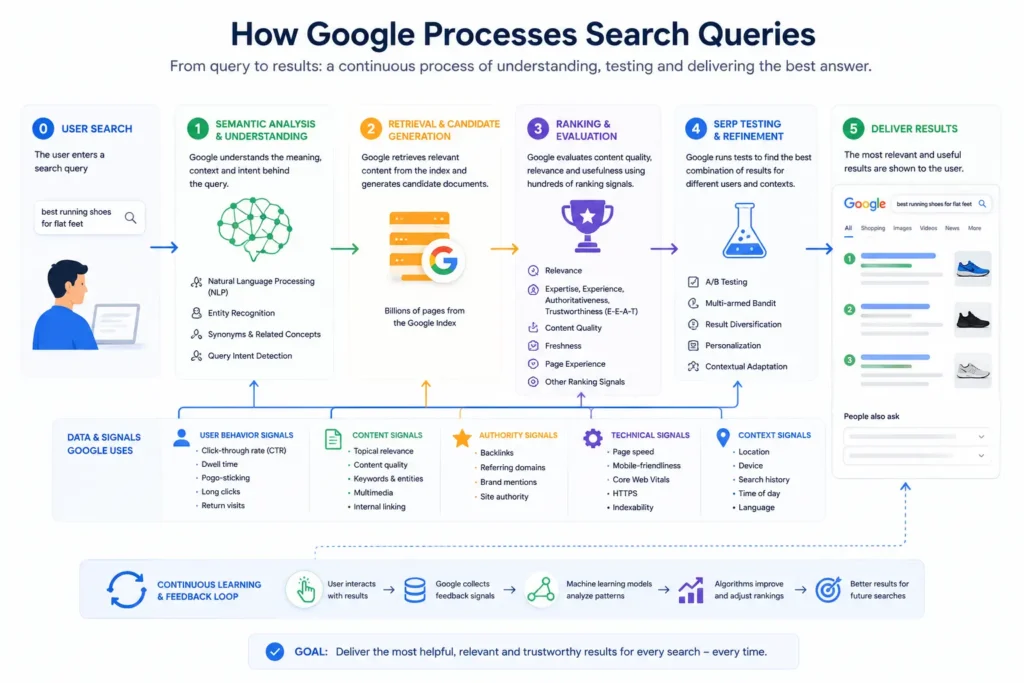
How Google Interprets User Intent
Google evaluates intent using multiple layers of analysis.
Query Structure
The wording itself reveals intent.
Examples:
- “how to” → informational
- “best” → comparative/commercial
- “buy” → transactional
- “near me” → local transactional
SERP Patterns
Google studies which content formats users prefer for specific queries.
If users consistently click:
- videos
- listicles
- product pages
- comparison tables
…Google adapts the search results accordingly.
That means your content format must align with the dominant SERP behavior.
Engagement Signals
Search engines monitor:
- bounce patterns
- click satisfaction
- return searches
- dwell time
If users return immediately to search results, the page may not satisfy intent effectively.
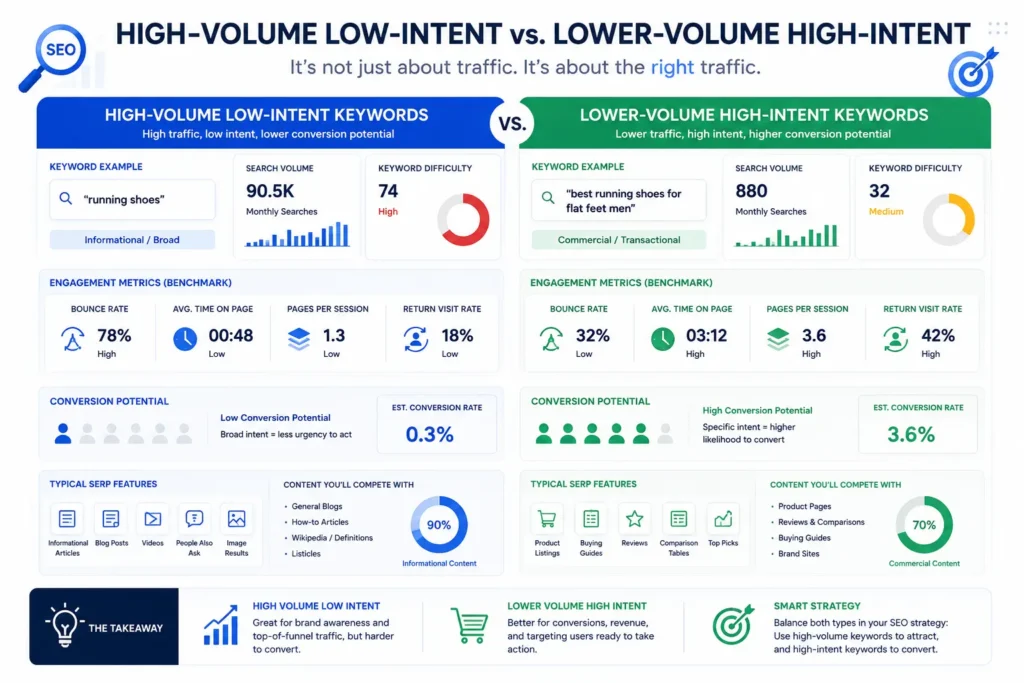
Keyword Intent vs Search Volume
High-volume keywords often look attractive on paper.
But intent determines actual business value.
For example:
| Keyword | Monthly Searches | Intent Quality |
|---|---|---|
| “SEO” | Very High | Broad / unclear |
| “best SEO tools for agencies” | Moderate | High commercial value |
| “how to fix indexing issues” | Lower | Strong targeted informational intent |
The third keyword may generate fewer visits but higher engagement and trust.
This is why advanced SEO strategies prioritize user intent over vanity traffic.
How to Identify Keyword Intent Accurately
Analyze the Existing Search Results
Search Google and observe:
- content type
- article structure
- SERP features
- ranking page formats
If the first page is filled with tutorials, Google likely interprets the query as informational.
If product pages dominate, the intent is commercial or transactional.
Look for Modifier Words
Intent often appears through modifiers like:
- best
- buy
- compare
- tutorial
- review
- pricing
- examples
- near me
- guide
These signals help classify keyword purpose quickly.
Use Behavioral SEO Thinking
Instead of asking:
“How do I rank for this keyword?”
Ask:
“What outcome is the user trying to achieve?”
That shift changes content quality dramatically.
The SEO Mistake Most Sites Keep Repeating
Many websites create:
- one generic article
- broad keyword targeting
- mixed search intent
- unclear page purpose
The result:
- weaker rankings
- lower engagement
- poor conversion flow
A page trying to satisfy informational, transactional, and navigational intent simultaneously often confuses both users and search engines.
Strong SEO pages usually solve:
one dominant intent clearly and efficiently.
How Keyword Intent Shapes Content Strategy
Intent should influence:
- headline structure
- page depth
- CTA placement
- media selection
- internal linking
- schema strategy
- content hierarchy
For example:
Informational Pages
Best for:
- authority building
- backlinks
- topical coverage
Transactional Pages
Best for:
- conversions
- lead generation
- product positioning
Commercial Investigation Pages
Best for:
- affiliate SEO
- SaaS acquisition
- comparison traffic
Intent alignment creates a cleaner content ecosystem across the entire site.
Semantic SEO and Intent Optimization
Modern SEO increasingly relies on semantic understanding.
This means search engines evaluate:
- related entities
- contextual relationships
- topical authority
- natural language patterns
A page discussing search intent naturally should also reference:
- SERPs
- query analysis
- ranking signals
- content relevance
- search behavior
- click patterns
This creates stronger semantic depth without keyword stuffing.
The Future of SEO Is Intent-First
AI-powered search systems are becoming better at:
- predicting needs
- understanding context
- interpreting conversational queries
- evaluating helpfulness
This changes SEO fundamentally.
Winning pages are no longer just optimized pages.
They are:
- context-aware
- intent-aligned
- behavior-friendly
- semantically connected
The websites that understand users more accurately will outperform websites that simply repeat keywords more often.
Final Thoughts
Keyword research without intent analysis is incomplete.
The most effective SEO strategies now begin with understanding:
- what the user wants
- why they searched
- what outcome they expect
- what format satisfies them fastest
Search engines reward content that resolves intent efficiently.
That means the real competitive advantage is no longer keyword density.
It is relevance, usefulness, and alignment with human behavior.
FAQs:
What is keyword intent in SEO?
Keyword intent refers to the reason behind a user’s search query. It helps search engines understand what type of content the user expects to find.
Why is search intent important for rankings?
Search intent improves relevance. When content aligns with user expectations, engagement signals improve, which can strengthen rankings over time.
What are the main types of search intent?
The four primary types are:
informational
navigational
transactional
commercial investigation
How does Google identify user intent?
Google analyzes query patterns, SERP behavior, engagement metrics, semantic context, and historical search data.
Can low-volume keywords have high SEO value?
Yes. Low-volume keywords with strong intent often produce better engagement and conversions than broad high-volume terms.
What is the difference between keywords and user intent?
Keywords are the words typed into search engines. User intent is the purpose or goal behind those words.
Summary:
Keyword intent is the foundation of modern SEO strategy. Understanding why users search helps create more relevant, engaging, and higher-performing content. Search engines increasingly prioritize intent satisfaction over exact keyword matching, making user-focused optimization essential for sustainable rankings.