
A page can have excellent writing, strong backlinks, and even decent traffic — yet still struggle to rank consistently.
The reason is often structural.
Search engines do not evaluate content the way humans do. They interpret hierarchy, relevance, topical relationships, semantic clarity, and usability signals. That entire layer sits inside on page SEO.
Many site owners focus heavily on publishing more content while overlooking how each page communicates intent to search engines. The result is scattered rankings, keyword overlap, weak indexing, and poor engagement metrics.
<u>On page SEO is not just about adding keywords. It is about making a page understandable, crawlable, and contextually complete.</u>
What On Page SEO Actually Includes
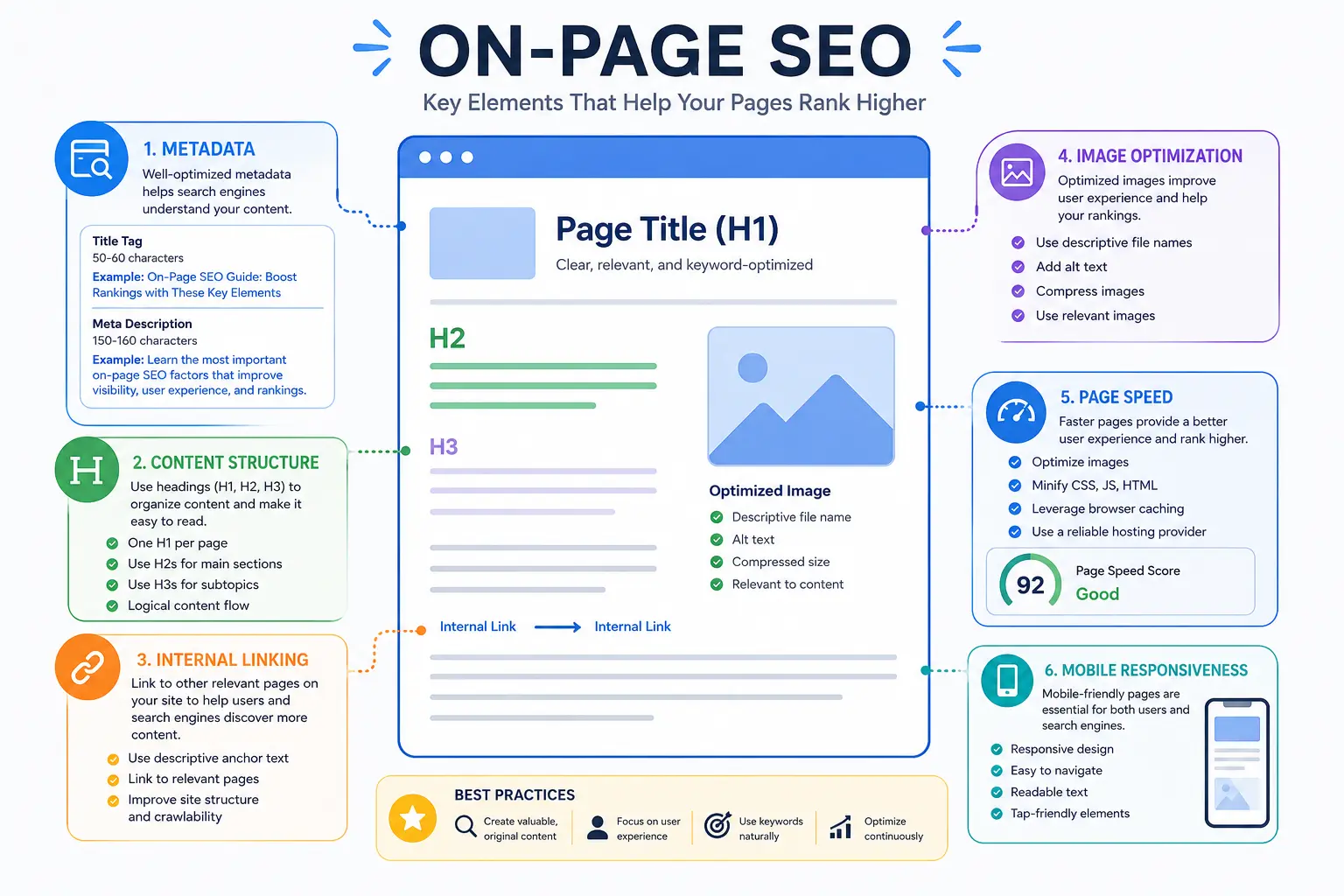
At its core, on page optimization refers to everything directly controlled within a webpage that influences search visibility.
That includes:
- Content structure
- Heading hierarchy
- Internal linking
- URL organization
- Metadata
- Image optimization
- Semantic keyword usage
- User experience signals
- Mobile readability
- Page speed
- Search intent alignment
A properly optimized page creates a clear relationship between:
- the topic,
- the search query,
- and the user’s expected outcome.
This is where many discussions around on page SEO and off page SEO become misleading. Off-page authority can amplify rankings, but weak on-page structure limits how effectively a page can perform in search.
Think of it this way:
- Off-page SEO builds trust.
- On page SEO builds clarity.
Without clarity, authority gets wasted.
Why Search Engines Depend on On Page Signals
Search engines attempt to understand:
- what a page is about,
- how comprehensive it is,
- and whether users find it useful.
They infer this through signals embedded within the page itself.
A well-optimized article helps search engines determine:
- topical depth,
- keyword relationships,
- content freshness,
- and contextual authority.
For example, a page about on-page optimization should naturally reference related concepts like:
- metadata,
- internal links,
- crawlability,
- semantic relevance,
- and user engagement.
That interconnected language helps search engines map the page into a broader topical ecosystem.
This is one reason modern SEO has shifted away from keyword repetition and toward semantic optimization.
The Most Important Elements of On Page Optimization
Content Depth and Search Intent
A page should answer the actual reason behind the query.
Someone searching “on page SEO guide” is usually looking for:
- practical implementation,
- ranking factors,
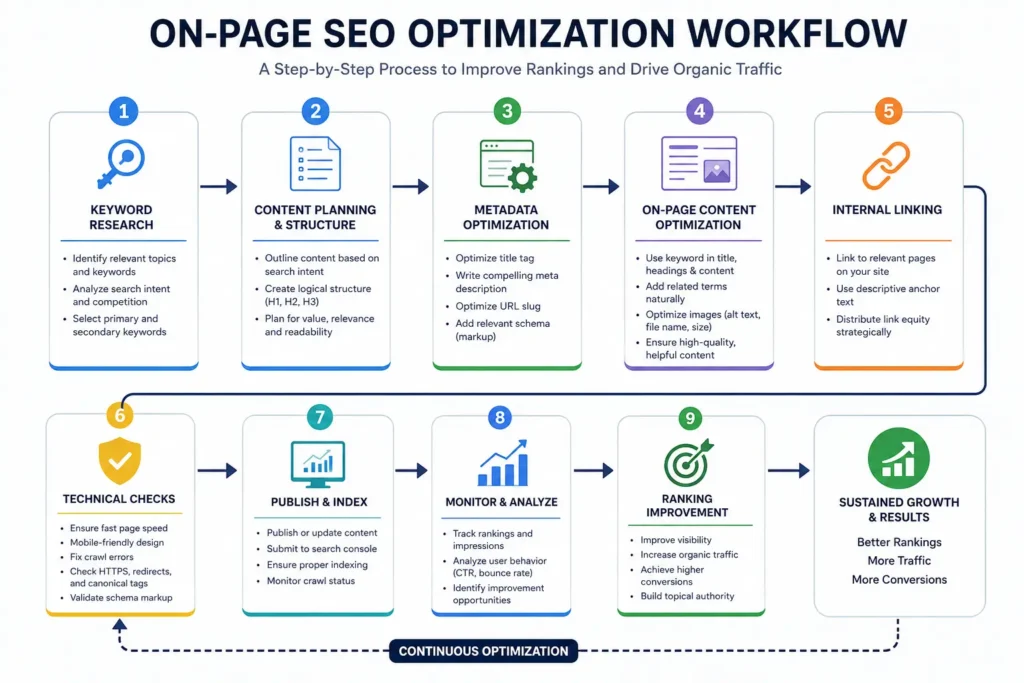
- optimization workflow,
- and actionable improvements.
Thin explanations no longer perform well against comprehensive search results.
High-performing pages typically:
- answer immediate questions quickly,
- expand into related subtopics,
- and organize information logically.
That combination improves:
- dwell time,
- engagement,
- and topical authority.
Heading Structure Matters More Than Most People Think
Search engines use headings to understand:
- hierarchy,
- topical segmentation,
- and contextual relationships.
A poor heading structure creates ambiguity.
A strong structure:
- improves readability,
- increases featured snippet opportunities,
- and helps semantic indexing.
Instead of generic headings like:
- “Tips for SEO”
- “SEO Basics”
use headings with contextual specificity:
- “How Internal Linking Shapes Topical Authority”
- “Why Metadata Influences Click Behavior”
- “The Hidden Cost of Keyword Cannibalization”
This improves both user experience and keyword relevance.
Internal Linking Is an SEO Multiplier
Internal links distribute authority across a website.
More importantly, they help search engines understand:
- content relationships,
- topical clusters,
- and page importance.
Strategic internal linking can:
- improve indexing speed,
- strengthen keyword associations,
- and reduce orphan pages.
Effective internal linking usually includes:
- descriptive anchor text,
- contextual relevance,
- and logical navigation paths.
Avoid excessive exact-match anchor repetition. Natural language performs better over time.
Metadata Still Influences Performance
Title tags and meta descriptions are often treated as minor SEO tasks.
They are not.
Your title tag affects:
- click-through rate,
- topical relevance,
- and keyword association.
A strong title should:
- communicate intent quickly,
- include the primary keyword naturally,
- and create informational value.
Meta descriptions may not directly influence rankings, but they strongly influence user clicks.
Higher engagement frequently correlates with stronger long-term visibility.
Image Optimization Is Often Overlooked
Search engines cannot fully interpret images without supporting context.
Optimized images should include:
- descriptive filenames,
- relevant alt text,
- compressed file sizes,
- and contextual placement.
This improves:
- accessibility,
- page speed,
- and image search visibility.
It also contributes to overall page quality signals.
Page Experience Is Now Part of SEO Performance
Modern search engines increasingly evaluate usability.
That includes:
- mobile responsiveness,
- loading speed,
- visual stability,
- and readability.
A technically optimized page with poor usability often underperforms.
Good on-page optimization balances:
- technical structure,
- content quality,
- and user interaction.
That balance is difficult to replicate with automation alone.
Essential On Page SEO Tools Worth Using
The best on page SEO tools are not always the most expensive ones.
Different tools solve different problems.
Content & Optimization Tools
- Surfer SEO — content structure and semantic optimization
- Clearscope — topical relevance analysis
- Frase — AI-assisted content research
Technical SEO Tools
- Screaming Frog SEO Spider — crawl audits and structural analysis
- Google Search Console — indexing and search performance
- PageSpeed Insights — speed and performance diagnostics
Keyword & Competitive Research
The ideal workflow combines:
- technical auditing,
- semantic optimization,
- and performance tracking.
Common On Page SEO Mistakes That Hurt Rankings
Even experienced site owners make structural mistakes.
Some of the most damaging include:
Keyword Cannibalization
Multiple pages targeting the same intent compete against each other.
Thin Content
Pages lacking depth struggle to establish topical authority.
Weak Internal Linking
Important pages become isolated and difficult to prioritize.
Over-Optimization
Forced keyword repetition reduces readability and trust.
Search Intent Mismatch
Content fails because it answers the wrong question.
SEO success often comes from fixing foundational weaknesses rather than chasing advanced tactics.
How On Page SEO and Off Page SEO Work Together
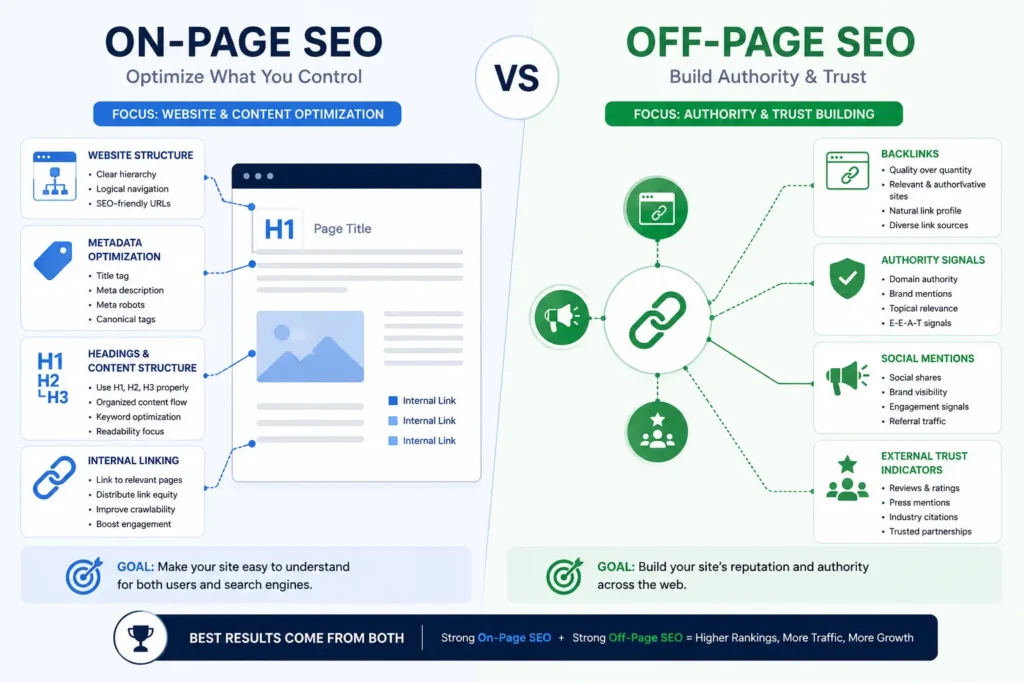
There is ongoing debate around on page SEO and off page SEO, but high-performing websites rely on both.
On-page SEO controls:
- clarity,
- relevance,
- structure,
- and usability.
Off-page SEO contributes:
- authority,
- trust,
- and external validation.
A strong backlink profile cannot fully compensate for poor page quality.
Likewise, excellent on-page optimization without authority may struggle in competitive niches.
The strongest SEO strategies align both.
The Future of On Page Optimization
Search engines are increasingly focused on:
- entity relationships,
- semantic understanding,
- behavioral signals,
- and contextual depth.
This changes how pages should be written.
The future of on page optimization is less about inserting keywords and more about:
- demonstrating expertise,
- organizing information clearly,
- and satisfying intent comprehensively.
Pages that feel genuinely useful tend to outperform pages built purely around ranking formulas.
That trend is becoming stronger every year.
Final Thoughts
Strong SEO performance rarely comes from isolated tricks.
It comes from pages that are:
- technically sound,
- semantically clear,
- structurally organized,
- and genuinely useful.
That is the real purpose of on page SEO.
Not manipulation.
Communication.
The websites that consistently rank well are usually the ones that make understanding effortless — for both users and search engines.
FAQs:
What is on page SEO?
On page SEO refers to the optimization of elements within a webpage to improve search visibility, user experience, and ranking performance.
What is the difference between on page SEO and off page SEO?
On-page SEO focuses on content, structure, and technical elements inside the website, while off-page SEO focuses on backlinks, authority, and external signals.
Which on page SEO tools are best for beginners?
Google Search Console, Screaming Frog, Ahrefs, and Surfer SEO are among the most useful tools for beginners and advanced users alike.
Does keyword density still matter?
Not in the traditional sense. Modern SEO prioritizes semantic relevance and intent satisfaction over repetitive keyword usage.
How important are headings in on page optimization?
Headings help search engines understand page structure and improve readability for users, making them a major on-page SEO factor.
Summary:
On page SEO improves how search engines and users understand a webpage. Effective optimization includes content structure, metadata, internal linking, semantic relevance, technical performance, and search intent alignment. Strong on-page foundations make every other SEO effort more effective.