
Search traffic rarely goes to the “best” article. Most of the time, it goes to the page that best matches intent and has enough authority to compete.
That’s where keyword difficulty becomes important.
Many websites fail before they gain traction because they target impossible keywords too early. A new blog tries to rank for “digital marketing,” a small SaaS company targets “CRM software,” or a niche store competes against global retailers with decades of authority.
The problem is not content quality alone. The problem is competition.
Understanding keyword difficulty helps you avoid wasting months on keywords you realistically cannot rank for yet.
Keyword Difficulty Meaning in SEO
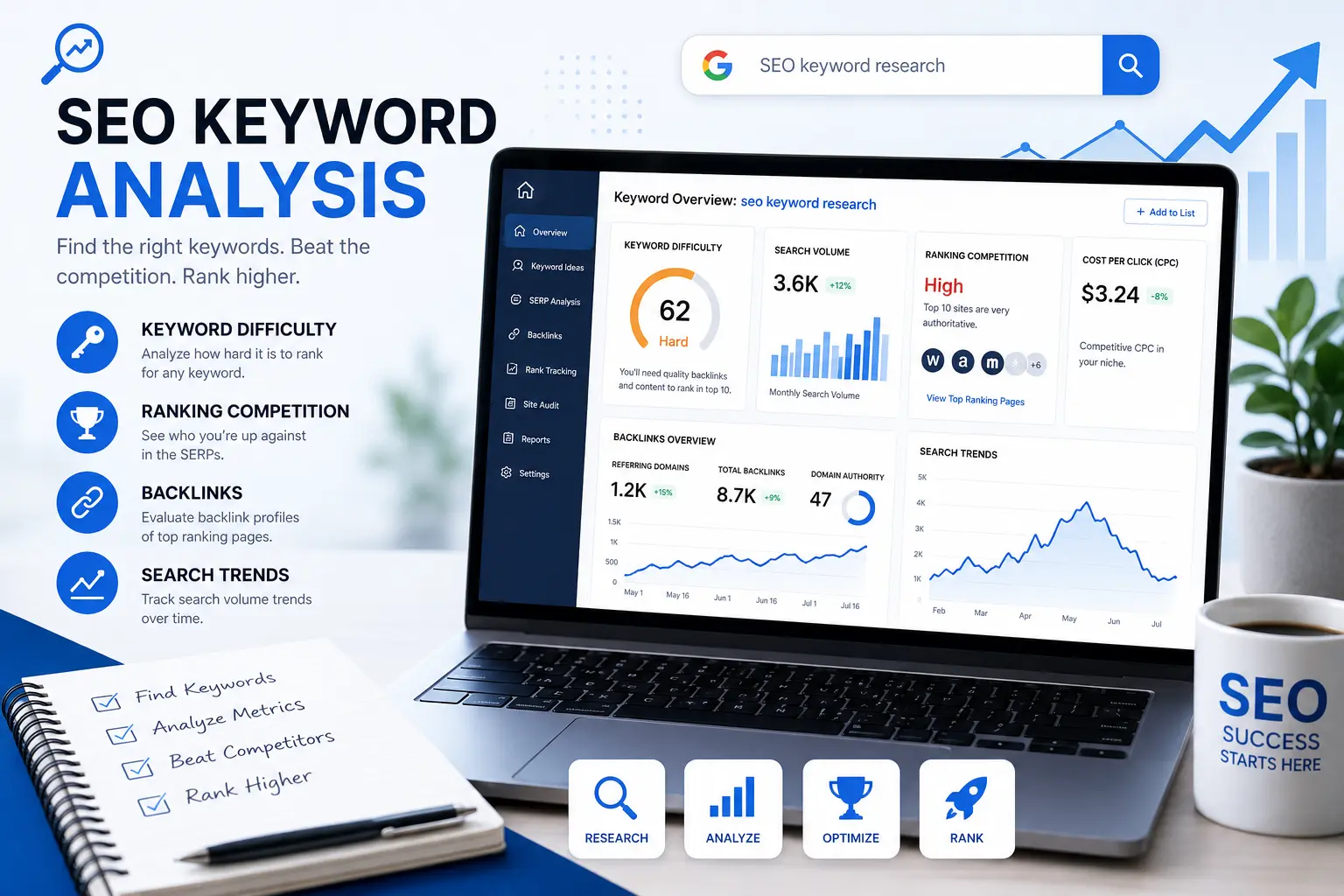
Keyword difficulty is an SEO metric that estimates how hard it would be to rank on the first page of search results for a specific keyword.
The score is usually presented on a scale from 0 to 100:
- 0–10: Extremely easy
- 11–30: Low competition
- 31–50: Moderate difficulty
- 51–70: Competitive
- 71–100: Very difficult
Different SEO tools calculate this score differently, but most systems analyze:
- Backlink strength
- Domain authority
- Content quality of ranking pages
- Search intent competition
- SERP saturation
- Brand dominance
- Internal linking strength
The higher the score, the stronger the competing pages tend to be.
Why Keyword Difficulty Matters More Than Search Volume
A keyword with 50,000 monthly searches looks attractive until you realize the first page is controlled by:
- Massive brands
- Government domains
- Established publishers
- High-authority SaaS companies
A lower-volume keyword with weaker competition often delivers faster results and better conversion potential.
For example:
| Keyword | Search Volume | Difficulty | Opportunity |
|---|---|---|---|
| “running shoes” | Very High | Extremely Hard | Low for small sites |
| “best running shoes for flat feet women” | Moderate | Medium | Much better |
| “lightweight trail shoes for beginners” | Lower | Easier | High potential |
Smart SEO is usually about achievable rankings, not vanity keywords.
Keyword Difficulty in SEO: What Actually Influences It?
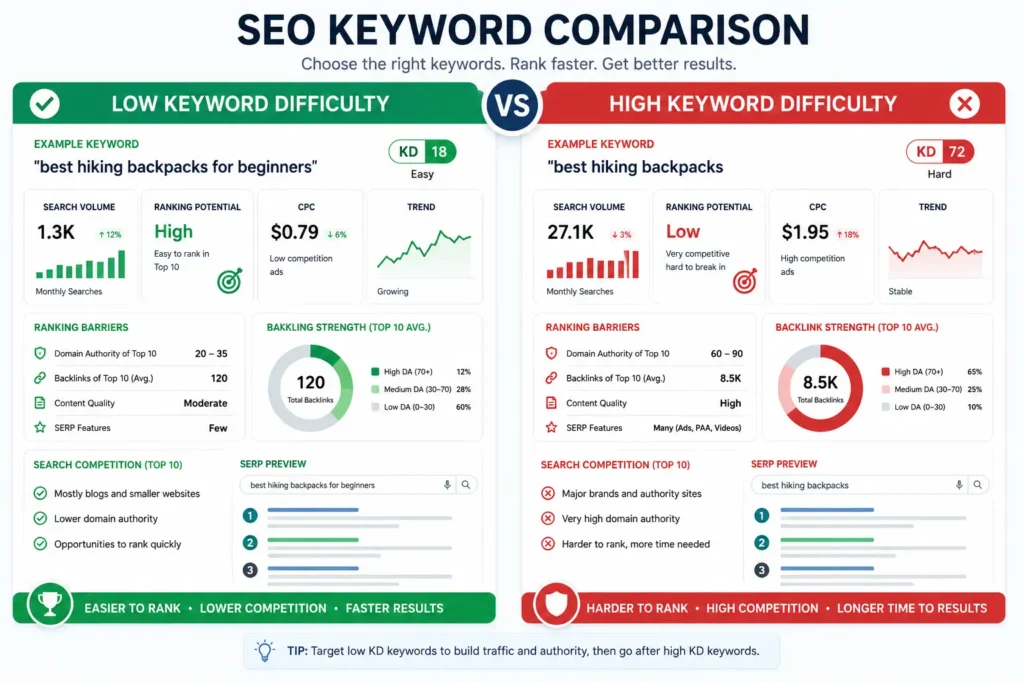
Most SEO tools use proprietary formulas, but the underlying signals are surprisingly consistent.
1. Backlink Profiles
If the top-ranking pages have thousands of referring domains, the keyword becomes harder to compete for.
Google still uses backlinks as a strong authority signal.
2. Domain Authority of Competitors
A SERP dominated by powerful websites creates a difficult environment for newer sites.
Examples include:
Even excellent content struggles against deeply trusted domains.
3. Search Intent Alignment
Some keywords appear easy numerically but are difficult because Google strongly prefers a specific content format.
For instance:
- Product pages
- Video results
- Comparison articles
- Forum discussions
- Local listings
If your page format does not match user intent, ranking becomes harder regardless of authority.
4. Content Depth and Freshness
Competitive SERPs often contain:
- Original research
- Updated statistics
- Expert commentary
- Visual assets
- Interactive tools
Thin content rarely survives in high-difficulty spaces.
5. SERP Features
Featured snippets, AI overviews, video carousels, and shopping blocks reduce organic visibility.
Sometimes the issue is not ranking difficulty — it is click difficulty.
What Is a Good Keyword Difficulty Score?
The answer depends on your website’s authority level.
For New Websites
Target keywords in the:
- 0–20 difficulty range
- Long-tail phrases
- Specific search intent
- Lower brand competition
This builds topical authority faster.
For Growing Websites
Once your site has backlinks and indexed content, you can gradually pursue:
- 20–40 difficulty keywords
- Mid-tail opportunities
- Commercial intent phrases
This is often the strongest growth phase for organic SEO.
For Established Websites
High-authority sites can compete for:
- Broad commercial terms
- High-volume keywords
- Competitive informational topics
But even large websites still rely heavily on strategic keyword clustering.
Why Long-Tail Keywords Often Win
A common SEO mistake is chasing traffic instead of precision.
Long-tail keywords usually offer:
- Lower competition
- Higher conversion rates
- Clearer intent
- Faster ranking potential
Example:
Instead of targeting:
A smarter early-stage strategy could target:
- “free keyword difficulty checker for beginners”
- “how keyword difficulty works in seo”
- “what is a good keyword difficulty score”
These phrases align better with user intent and realistic ranking opportunities.
Free Keyword Difficulty Checker Tools Worth Using
Several SEO platforms offer free or partially free keyword difficulty analysis.
Popular Options
- Ahrefs Free Keyword Generator
- Semrush Keyword Overview
- Ubersuggest
- Moz Keyword Explorer
- Mangools KWFinder
These tools estimate competition differently, so scores may vary.
A keyword rated “28” in one platform may appear as “41” elsewhere.
The score itself matters less than the SERP reality.
How to Evaluate Keyword Difficulty Manually
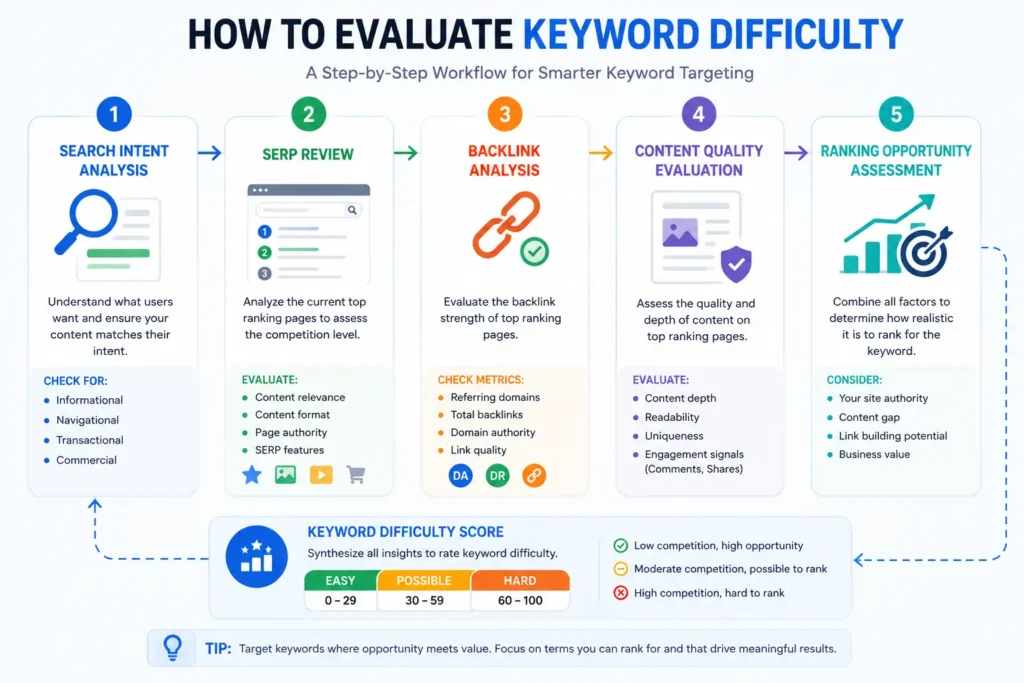
SEO tools help, but manual analysis gives better context.
Here’s a faster way to evaluate real ranking potential.
Check the Top 10 Results
Look for:
- Weak forums ranking
- Reddit threads
- Quora pages
- Small niche blogs
- Outdated articles
These are signs the SERP may be vulnerable.
Analyze Content Quality
Ask:
- Is the content shallow?
- Is the information outdated?
- Are headings poorly structured?
- Is intent mismatched?
- Are there missing visuals or examples?
Weak content inside a medium-difficulty SERP creates opportunities.
Evaluate Search Intent Consistency
If Google shows mostly:
- Tutorials
- Listicles
- Product pages
- Videos
Then your page must follow that pattern.
Intent mismatch quietly destroys rankings.
The Hidden Problem With Keyword Difficulty Scores
Many marketers treat difficulty scores as absolute truth.
They are not.
Two keywords with the same difficulty score can have completely different ranking realities.
For example:
- One may require strong backlinks
- Another may reward topical depth
- Another may depend on freshness
- Another may favor user-generated content
SEO tools simplify competition into numbers, but Google evaluates far more contextually.
<u>Keyword difficulty is a directional signal — not a guarantee.</u>
How Topical Authority Changes Keyword Difficulty
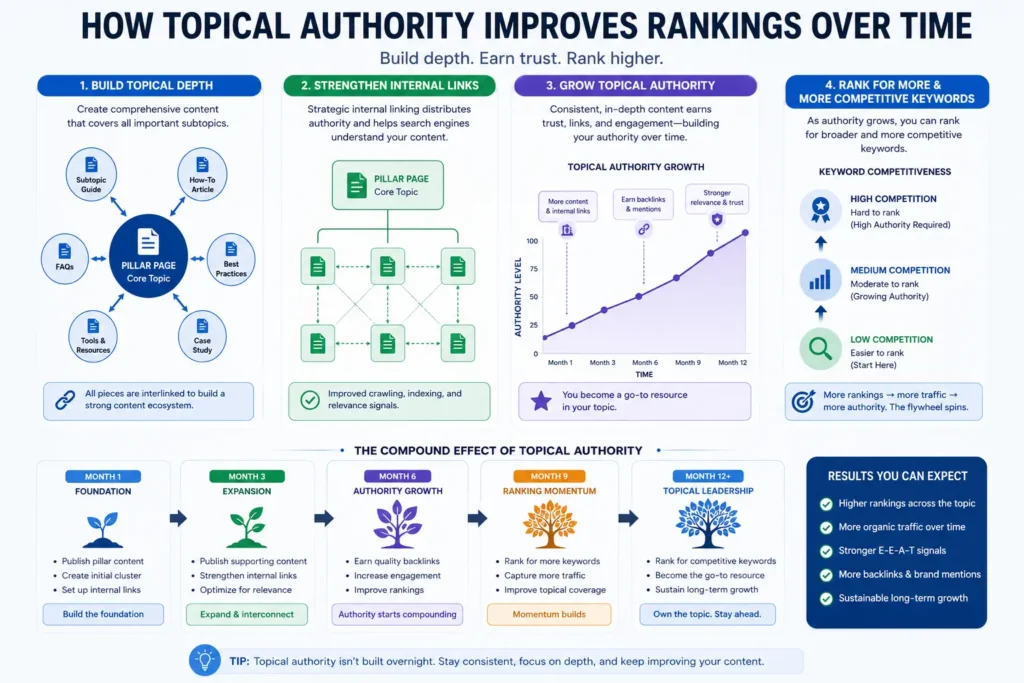
As your website gains authority within a niche, difficult keywords become easier to rank.
For example:
A site with 200 articles about fitness may rank for competitive exercise terms more easily than a general website with higher domain authority.
Google increasingly evaluates:
- Topical depth
- Semantic relationships
- Internal linking
- Entity relevance
- Content consistency
This is why focused niche sites often outperform broader websites.
Practical Keyword Difficulty Strategy for Smaller Websites
A smarter growth strategy looks like this:
Phase 1: Easy Long-Tail Keywords
Build indexed content and early authority.
Phase 2: Topic Clusters
Create interconnected articles around a core subject.
Phase 3: Mid-Difficulty Targets
Expand into competitive commercial phrases.
Phase 4: Authority Keywords
Compete for broad industry-level searches.
This layered approach compounds SEO strength over time.
Final Thoughts on Keyword Difficulty
The goal is not to find the easiest keyword.
The goal is to find the best balance between:
- Ranking potential
- Search intent
- Traffic quality
- Business relevance
- Competition level
Many websites grow faster by targeting winnable keywords consistently instead of chasing impossible search terms.
Keyword difficulty is ultimately a filtering system. It helps you prioritize opportunities where your content has a realistic chance to earn visibility.
And in modern SEO, strategic realism usually outperforms aggressive ambition.
FAQs:
What is keyword difficulty in SEO?
Keyword difficulty is an SEO metric that estimates how hard it is to rank for a keyword based on competition, backlinks, authority, and SERP strength.
What is a good keyword difficulty score?
For newer websites, a good keyword difficulty score is usually between 0 and 20. Established sites can target more competitive ranges.
Are free keyword difficulty checker tools accurate?
They are useful estimates, but every platform calculates difficulty differently. Manual SERP analysis is still important.
Does higher keyword difficulty mean better traffic?
Not always. High-difficulty keywords may bring traffic but can also be harder to rank for and less conversion-focused.
Can small websites rank for difficult keywords?
Yes, especially through topical authority, strong content clusters, and long-tail keyword strategies.
Why do keyword difficulty scores vary between tools?
Each SEO platform uses its own algorithm, backlink database, and ranking factors to calculate difficulty.
Summary:
Keyword difficulty helps SEO professionals evaluate how competitive a keyword is before investing time into content creation. Understanding search intent, SERP quality, backlinks, and topical authority allows websites to target realistic opportunities and build organic growth strategically.